
Elastomeric Coatings and the Chemistry That Sets Polyurea Apart
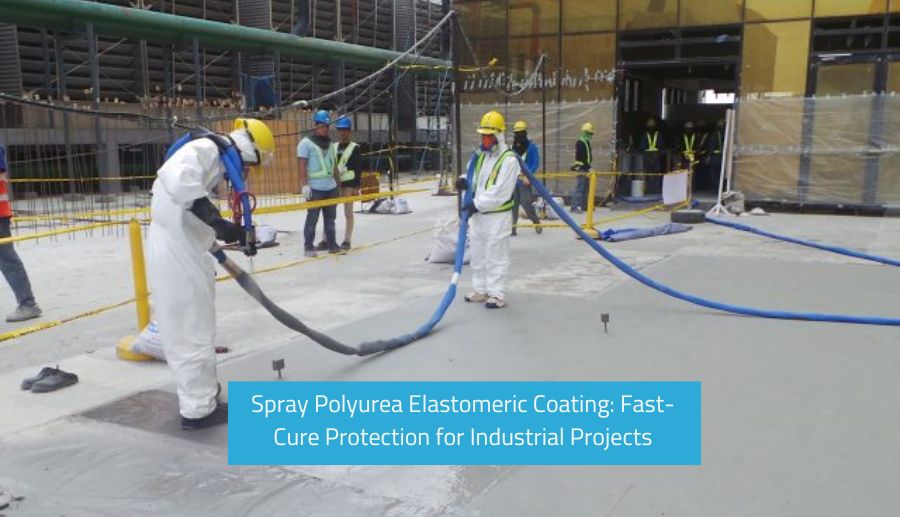
Spray polyurea elastomeric coating is a fast-cure, moisture-insensitive protective system engineered for large-scale industrial and infrastructure applications. With gel times measured in seconds and exceptional elongation properties, it outperforms conventional coatings where downtime, environmental exposure and surface continuity are non-negotiable. This article examines the chemistry behind its rapid crosslinking, why moisture resistance matters on active job sites and how polyurea has become the dominant choice for high-throughput industrial coating programs across the United States.
Elastomeric coatings are polymer-based systems that return to their original form after deformation – a critical property for substrates that expand, contract or shift under load. Within this category, polyurea stands apart due to its chemical architecture: the reaction between an isocyanate component (Part A) and an amine-terminated resin blend (Part B).
Unlike polyurethane coatings, which rely on hydroxyl groups and produce urethane linkages sensitive to moisture, polyurea chemistry produces urea linkages via amine-isocyanate reactions. This distinction is functionally significant: urea bonds form faster and are inherently moisture-insensitive. On large industrial job sites – bridge decks, containment berms, water treatment tanks, tunnel linings – humidity and surface condensation are unavoidable. A polyurea system does not require bone-dry conditions or controlled environments to cure properly.
The isocyanate index, stoichiometric ratio of NCO to NH₂ groups, is typically tuned between 1.05 and 1.15 in high-performance formulations. This slight excess of isocyanate ensures complete reaction, minimizes unreacted amine residue and drives consistent tensile strength, often reaching 3,000 to 4,000 psi in pure polyurea systems.
Polyurethane Coatings vs. Pure Polyurea - Understanding the Hybrid Spectrum
The terms are often conflated, but the distinction matters for specification engineers. Polyurethane coatings use polyols (hydroxyl-functional) with isocyanates. They offer excellent chemical resistance and adhesion but require relative humidity below 75–80% during application and have cure windows measured in hours, not seconds.
Polyurea-polyurethane hybrids blend amine and hydroxyl components in Part B. They sacrifice some of the speed of pure polyurea for improved flow and pot life – useful for detailed geometries or complex substrates. Pure polyurea systems, by contrast, are formulated for flat-out throughput: tanks, roofs, containment floors, bridge decks and secondary containment liners on industrial facilities.
Nukote Coating Systems formulates both pure polyurea and hybrid polymer coating solutions, allowing project engineers to select chemistries matched to substrate conditions, application geometry and regulatory requirements rather than defaulting to a one-size-fits-all product.
Read Our Article
The Role of Elastomeric Coatings in Infrastructure ProtectionGel Time Measured in Seconds - Why This Dominates Large-Area Projects
Gel time is the interval from impingement (mixing at the spray gun tip) to the point where the coating becomes a non-flowable gel. In spray polyurea systems, this is typically 2 to 6 seconds. Complete tack-free cure follows in 15 to 30 seconds. Return-to-service, depending on formulation, ranges from 1 to 4 hours – versus the 8 to 24 hours associated with standard two-component polyurethane coatings.
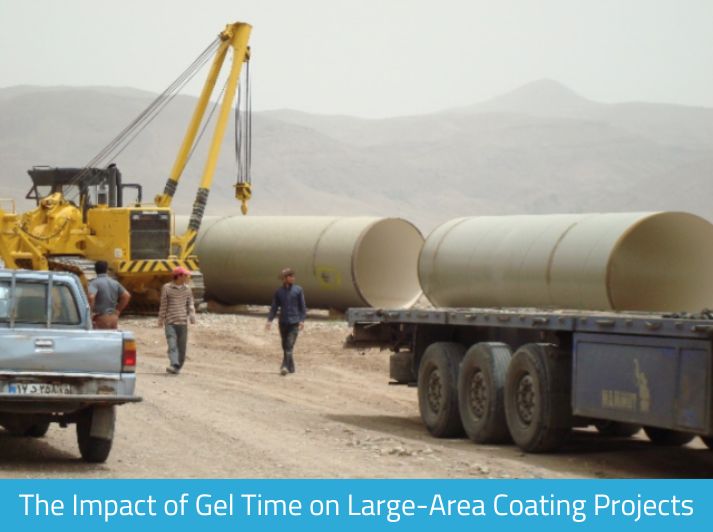
This speed is not merely a convenience metric. On large infrastructure projects – water containment facilities, airport tarmac coatings, pipeline exteriors – the cost of downtime can run into tens of thousands of dollars per day. A crew applying polyurea to a 50,000 square foot secondary containment floor can realistically complete the work and return the facility to operation within a single shift.
Spray application using plural-component proportioners ensures that Part A and Part B reach the impingement tip in precise ratio. Spray polyurea technology requires dedicated heated, proportioned equipment – a capital constraint that separates trained applicators from generalist contractors, which is why partnering with an experienced elastomeric coating manufacturer matters for large-scale bid specifications.
Moisture Insensitivity - the Decisive Advantage on Active Infrastructure Sites
Polyurethane coatings react with ambient moisture, producing CO₂ gas that creates bubbles, pinholes and adhesion failures when relative humidity exceeds threshold limits. Polyurea’s amine-isocyanate reaction pathway is not catalyzed or disrupted by water – the reaction is faster than moisture interference can occur.
This property has direct consequences for infrastructure coating contractors working on bridges, tunnels and coastal industrial facilities where dew points shift within a single workday. SSPC (Society for Protective Coatings) and NACE International guidelines require polyurethane applicators to halt work when surface temperature falls within 5°F of the dew point. Spray polyurea can continue application in conditions that would shut down a polyurethane crew entirely.
Nukote Coating Systems formulates spray polyurea systems specifically for marine infrastructure, potable water tanks and secondary containment environments where moisture exposure is inherent rather than exceptional. Compliance with NSF/ANSI 61 for potable water contact, USDA acceptance for food-processing environments and independent testing against ASTM D638 tensile and D412 elongation standards are standard qualification criteria for polyurea products in U.S. infrastructure programs.
Our Other Product
Elastomeric and Ployurea CoatingsPolyurea Elongation and Crack-Bridging in Structural Coatings
A core mechanical advantage of spray polyurea is elongation at break, typically 300% to 600% for industrial-grade formulations. Concrete substrates crack. Steel substrates vibrate and flex under dynamic loads. A coating that cannot accommodate movement will debond, crack and fail – regardless of its initial adhesion values.
Elastomeric polyurea films maintain integrity over cracks up to 1/8 inch in concrete without fracture, a property critical in bridge deck waterproofing, stadium floors and seismic-zone industrial floors. This crack-bridging performance, combined with abrasion resistance values that routinely outperform epoxy and polyurethane coatings on Taber abraser tests, is why project engineers at major infrastructure clients across the U.S. specify polyurea by chemistry type rather than generic “coating.”
Polyurethane Coating Manufacturer in Texas and the Regional Industrial Market
The Gulf Coast industrial corridor – spanning Texas, Louisiana and the broader southeastern U.S. – concentrates petrochemical processing, pipeline infrastructure, tank farms and heavy manufacturing within a geography defined by high humidity, thermal cycling and corrosive chemical environments. These are conditions that reveal the limitations of conventional coating systems within two to three service years.
Nukote Coating Systems, based in Texas, develops and manufactures spray polyurea and polyurethane hybrid systems engineered for this operational environment. The proximity to Gulf Coast industry is not incidental – product formulations are tested and qualified in the conditions that define the region’s coating challenges. For a polyurethane coating manufacturer in Texas developing products for local petrochemical clients, ambient humidity resistance, UV stability for exposed outdoor surfaces and substrate adhesion over steel, concrete and GRP are the baseline requirements, not premium features.
Elastomeric Coatings: Specification, Application and Quality Assurance Standards in USA
The U.S. industrial coatings market operates within a structured framework of specification standards. SSPC-SP 6/NACE No. 3 commercial blast or SSPC-SP 10 near-white blast are typical surface preparation requirements for polyurea on steel. Concrete substrates require minimum ICRI CSP 3-5 surface profile to achieve adequate mechanical adhesion.
Elastomeric coatings USA procurement increasingly demands third-party validation: QUV weatherometer data for UV resistance, pull-off adhesion testing to ASTM D4541, Shore A/D hardness values and permeance testing to ASTM E96 for vapor transmission. Large infrastructure owners – departments of transportation, Army Corps of Engineers, wastewater authorities – have moved toward polyurea performance specifications rather than proprietary product specifications, which places the burden on the elastomeric coating manufacturer to document chemistry and test data rather than simply submit a product data sheet.
For polymer coating solutions to qualify on federal or state infrastructure programs, manufacturers must maintain third-party test documentation that covers chemical resistance, tensile strength, elongation, adhesion and cure time under the range of ambient conditions likely on the project site.
Why Spray Polyurea Dominates Large-Area Industrial Applications
The convergence of fast cure, moisture insensitivity, high elongation and seamless monolithic application makes spray polyurea the dominant choice for high-throughput industrial coatings programs. Competing technologies each surrender at least one dimension: epoxy coatings offer chemical resistance but zero elongation and sensitivity to moisture during cure; polyurethane coatings offer good adhesion but moisture sensitivity and slow cure; rubberized asphalt systems offer crack-bridging but limited chemical resistance and poor UV stability.
Spray polyurea delivers all four simultaneously, at application rates of 2,000 to 5,000 square feet per shift per operator with proper plural-component equipment. At industrial scale – containment pond liners, bridge deck membranes, industrial floor systems – this throughput advantage compounds across the project timeline and directly reduces contract cost.
Conclusion
Spray polyurea’s combination of second-scale gel time, moisture-insensitive cure chemistry and crack-bridging elongation has made it the benchmark protective coating for large-scale industrial and infrastructure programs in the United States. For project engineers specifying polymer coating solutions on bridge decks, containment structures, water infrastructure or heavy industrial floors, polyurea addresses the performance gaps that conventional systems cannot bridge – and Nukote Coating Systems, as a reliable elastomeric coating manufacturer, provide the product chemistry, documentation and application expertise that these programs demand.
Table of Contents