
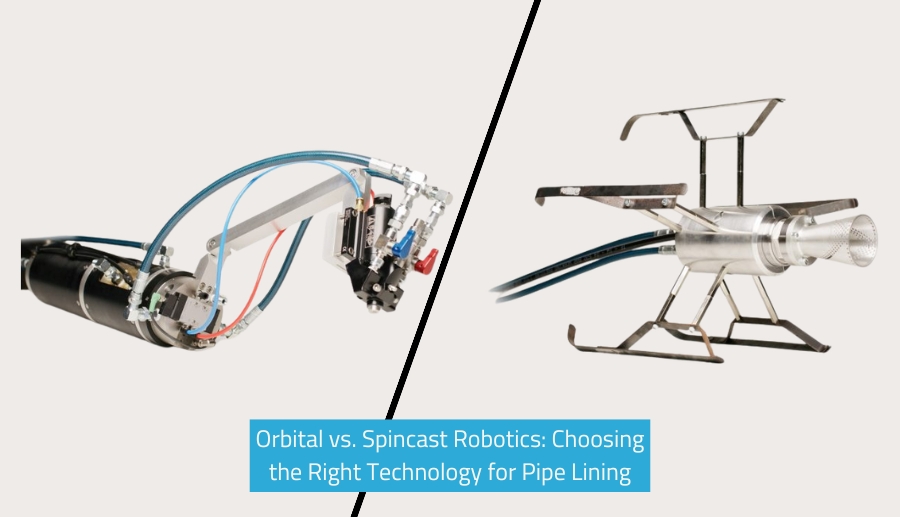
Robotic application has become the standard for lining large diameter pipes, manholes and structures where consistent coating thickness, worker safety and confined space compliance are priorities. Two robotic technologies dominate this space: orbital spray robots and spincast (centrifugal) robots. They solve the same basic problem, applying a uniform coating to the interior of a pipe or structure, but they do it in different ways and each is better suited to certain pipe diameters, coating materials and project conditions.
What Orbital Spray Robotics Does
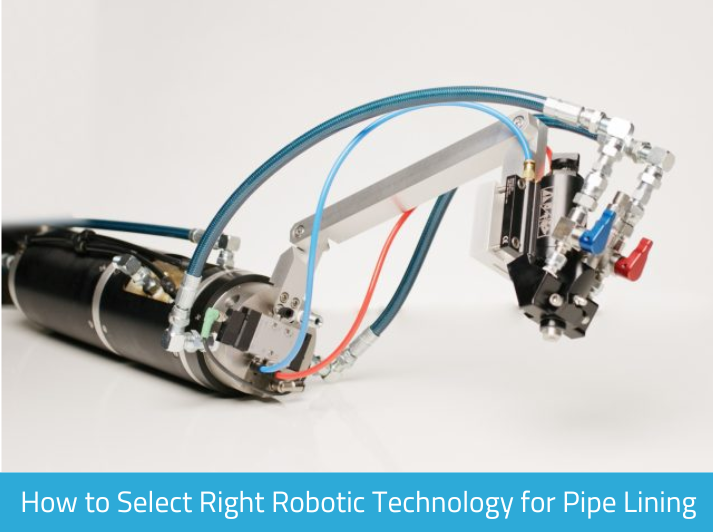
An orbital spray robot uses a rotating spray head mounted on a carriage that travels through the pipe. The head sprays coating material outward in a circular pattern while advancing along the pipe axis, building the coating in controlled passes.
Typical characteristics of orbital application:
- Well suited to a wide range of pipe diameters, from smaller diameter laterals up through large trunk lines.
- Compatible with a broad range of coating chemistries, including polyurethane, polyurea and epoxy systems.
- Allows precise control of dry film thickness by adjusting travel speed, rotation speed and number of passes.
- Effective for pipes with irregular geometry, offsets, bends or varying diameter, since the carriage can be guided and speed adjusted as it travels.
What Spincast Robotics Does
Spincast robotics , also called centrifugal casting, uses a spinning head that flings coating material outward against the pipe wall using centrifugal force as the unit is pulled or driven through the pipe at a controlled rate.
Typical characteristics of spincast application:
- Capable of very high material output, making it efficient for larger diameter pipe with substantial surface area to cover.
- Produces a consistent, monolithic film when pipe geometry is regular and diameter is constant along the run.
- Often paired with fast set materials, since the centrifugal method is built around continuous forward movement and rapid buildup of film thickness.
- Generally most efficient in long, straight runs of pipe rather than sections with frequent bends or diameter changes.
Orbital Versus Spincast: Side by Side Comparison
| Factor | Orbital Spray Robotics | Spincast Robotics |
|---|---|---|
| Pipe diameter range | Broad range, including smaller and irregular diameters | Best suited to larger, consistent diameters |
| Pipe geometry | Handles bends, offsets and diameter changes well | Performs best in straight, uniform runs |
| Coating chemistry flexibility | Wide range of spray applied materials | Typically paired with fast set, high build materials |
| Application speed | Controlled by pass count and travel speed | High output per pass, efficient for large surface areas |
| Thickness control | Fine control through multiple adjustable passes | Effective for consistent, high build monolithic coats |
| Typical use case | Complex pipe networks, varied diameters, precision lining | Long straight trunk lines, high volume rehabilitation |
Our Other Product
Elastomeric and Ployurea CoatingsQuestions to Ask Before Selecting a Robotic Lining Method
- What is the pipe diameter, and does it vary along the length of the run? Consistent diameter favors spincast, while variable diameter often favors orbital application.
- How many bends, offsets or fittings are present? Complex geometry generally favors the maneuverability of orbital carriages.
- What coating material has been specified for the project, and is it formulated for spray application, centrifugal application, or both?
- What is the required dry film thickness, and does the project call for multiple thin passes or a single high build application?
- What are the access points and confined space conditions, since robot size, cable length and launch pit configuration both affect which system can be deployed efficiently on a given site?
- What is the project timeline and total footage to be lined? Larger, straighter projects often benefit from the throughput of spincast equipment, while precision sensitive or geometrically complex projects often benefit from orbital control.
Safety and Compliance Considerations
Robotic lining technologies, whether orbital or spincast, are widely used specifically because they reduce the need for personnel entry into pipes and confined spaces classified under regulations such as OSHA 29 CFR 1910.146 in the United States. Remote operation also supports more consistent quality control, since application parameters such as rotation speed, travel speed and material output can be logged and repeated across a project rather than depending entirely on manual technique.
Making the Final Decision
Neither orbital nor spincast robotics is universally superior. The right choice depends on pipe diameter and geometry, the coating material specified, the required film thickness and the scale of the project. Many pipe rehabilitation programs use both technologies across a single system, applying spincast robots to long straight trunk sections and orbital robots to smaller diameter laterals, manholes or geometrically complex segments. Reviewing project specific pipe conditions with an experienced robotic lining provider before finalizing equipment selection helps ensure the application method matches both the coating chemistry and the physical realities of the pipe network being rehabilitated.
Table of Contents