
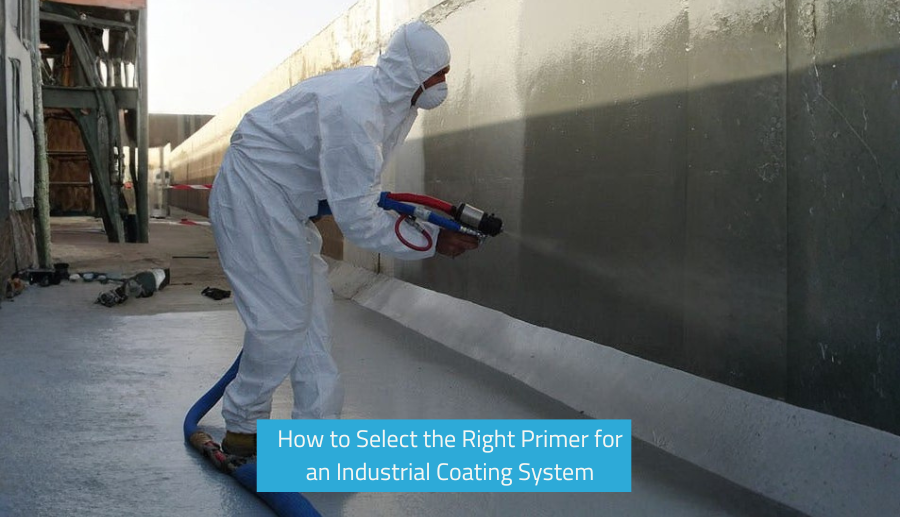
Selecting the right primer is often the single most important decision in an industrial coating system, yet it receives far less attention than the visible topcoat. A primer’s job is to bond tightly to the substrate, resist the specific exposure conditions at the site, and create a chemically compatible surface for the topcoat above it. Getting any one of those three factors wrong is one of the leading reasons coating systems fail early, regardless of how good the topcoat itself is.
Why Primer Selection Cannot Be an Afterthought
A primer sits between two very different materials: the raw substrate and the finished coating. It has to solve adhesion problems the topcoat alone cannot, including:
- Bonding to porous, uneven or chemically reactive substrates such as concrete, cast iron, galvanized steel or previously coated surfaces.
- Providing corrosion inhibition on ferrous metals through barrier, sacrificial or inhibitive mechanisms.
- Sealing porosity in concrete and masonry to prevent outgassing that leads to pinholing or blistering in the topcoat.
- Establishing a compatible chemical interface so the topcoat cures properly and bonds rather than lifting or wrinkling.
Matching Primer to Substrate Type
Different substrates require fundamentally different primer chemistries and surface preparation approaches.
| Substrate | Primary Concern | Common Primer Approach |
|---|---|---|
| Carbon steel | Corrosion and flash rusting | Epoxy or zinc rich primers after abrasive blasting to a near white or commercial grade finish |
| Concrete and masonry | Porosity, moisture vapor, laitance | Penetrating epoxy or silane siloxane based primers that seal and consolidate the surface |
| Galvanized and aluminum | Poor adhesion of standard primers to smooth, low surface energy metals | Etching primers or specialty adhesion promoters designed for non ferrous metals |
| Previously coated surfaces | Unknown chemistry, possible incompatibility | Test patch application and a tie coat or bridging primer where compatibility is uncertain |
| Pipe interiors and lined vessels | Immersion service, chemical exposure | High build epoxy or novolac primers rated for the specific fluid in contact |
Surface profile requirements for metal substrates are commonly specified using SSPC and AMPP (formerly NACE International) joint standards, while concrete surface preparation is often referenced against ICRI guideline 310.2, which grades concrete surface profiles on a numbered scale.
How Environmental Exposure Changes the Primer Decision
The same substrate can call for a different primer depending on where the asset is located and what it is exposed to.
- Immersion versus atmospheric exposure: a primer suitable for outdoor atmospheric exposure on a storage tank exterior is not automatically suitable for the same tank’s interior if it holds water, chemicals or wastewater.
- UV and weathering exposure: primers that will remain exposed for any length of time before topcoating benefit from UV resistant chemistry to avoid chalking or amine blush that interferes with topcoat adhesion.
- Chemical exposure: acidic, caustic or solvent exposure calls for primers formulated with specific chemical resistance, verified against the coating manufacturer’s published resistance chart rather than assumed from a general product category.
- Temperature extremes: primers used in cold storage facilities, high temperature process equipment or areas with wide daily temperature swings need to be selected for their performance across that specific range, not only at standard ambient conditions.
- Humidity and moisture vapor: high humidity environments and below grade or slab on grade concrete applications often require moisture tolerant or moisture cured primer chemistries capable of bonding even when residual moisture is present.
Our Other Product
Elastomeric and Ployurea CoatingsPrimer and Topcoat Compatibility
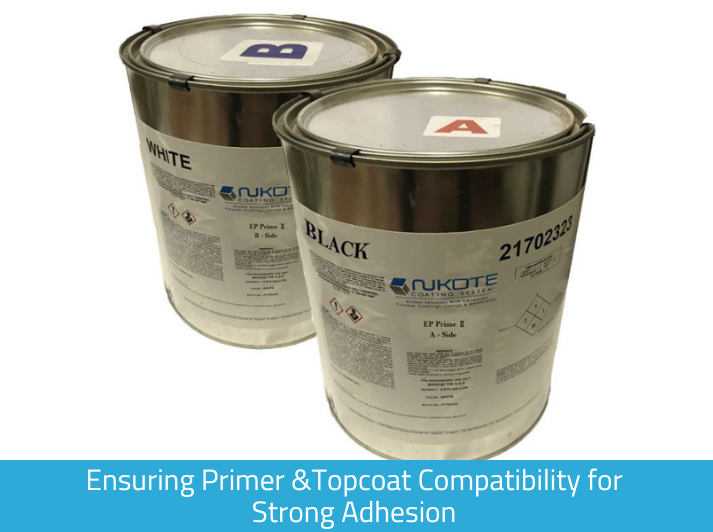
A primer that performs well on its own can still cause a system failure if it is not chemically compatible with the topcoat applied over it. Points to verify before finalizing a coating system:
- Confirm the primer and topcoat are documented by the manufacturer as a tested, compatible system rather than combined based on general product category alone.
- Check the recoat window on the primer’s technical data sheet. Recoating too early can trap solvents; recoating too late can cause the surface to glaze over and reduce intercoat adhesion.
- Review solvent compatibility, since a strong solvent topcoat applied over an incompletely cured primer can lift or wrinkle the film.
- Match the generic type where possible. Epoxy primers generally pair well with epoxy or polyurethane topcoats, while cementitious primers are typically paired with compatible cementitious or elastomeric topcoats.
A Practical Framework for Choosing a Primer
When specifying or selecting a primer for an industrial coating system, working through the following sequence reduces the risk of premature failure:
- Identify the substrate and its condition, including porosity, existing coatings and surface contamination.
- Define the service environment: atmospheric, immersion, chemical splash, buried, or below grade.
- Determine the required surface preparation standard and verify it can be achieved on site.
- Select a primer chemistry rated for both the substrate and the environmental exposure.
- Confirm compatibility with the intended topcoat, ideally using a system tested and documented by a single coatings manufacturer.
- Apply within the primer’s stated temperature, humidity and dew point parameters, and respect minimum and maximum recoat windows.
Primer Selection as System Design, Not a Single Product Choice
Choosing a primer is really an exercise in coating system design. The substrate defines what the primer has to bond to, the environment defines what it has to resist, and the topcoat defines what it has to remain compatible with over the life of the asset. Treating primer selection as one part of an engineered system, supported by documented compatibility data and recognized surface preparation standards, produces far more consistent long-term performance than selecting a primer in isolation based on cost or general category alone.
Table of Contents