
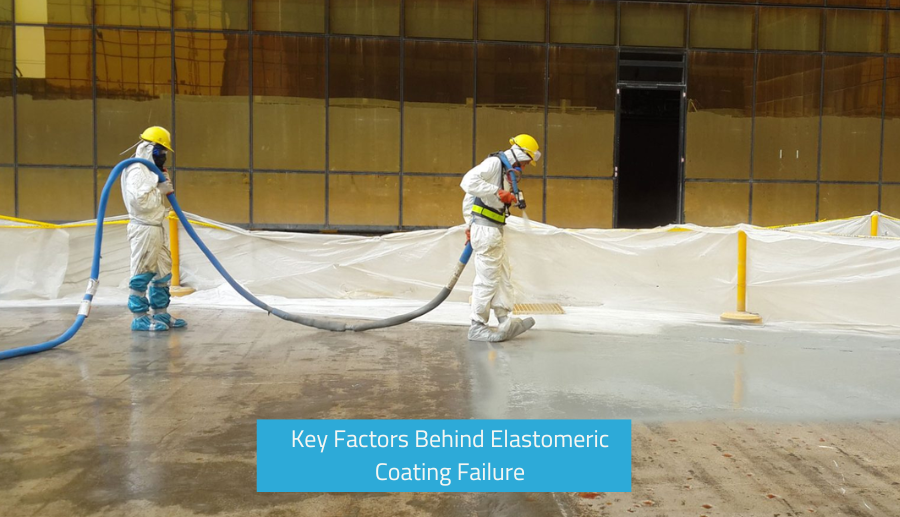
Elastomeric coatings are chosen for their flexibility, waterproofing performance and ability to bridge hairline cracks in concrete, metal and roofing substrates. Yet even a well formulated elastomeric coating can fail prematurely when application conditions, surface preparation or product selection are not aligned with the environment the coating has to survive in. Understanding why elastomeric coatings blister, peel, crack or delaminate is the first step toward preventing costly rework and extending the service life of a protective coating system.
What Counts as Elastomeric Coating Failure
Coating failure is any condition where the film no longer performs its intended function of adhesion, waterproofing or protection. The four failure modes that facility owners, applicators and specifiers encounter most often are:
- Blistering: raised, dome shaped bubbles in the film caused by trapped gas, moisture or solvent vapor pushing against the coating from beneath.
- Peeling: sheets or flakes of coating lifting away from the substrate, usually starting at edges, seams or penetrations.
- Cracking: fine lines or splits in the film surface, often a sign the coating has lost its elasticity or was applied too thin.
- Delamination: separation between coating layers or between the coating and substrate, frequently the most serious of the four because it can affect an entire section of a roof, tank or wall system.
Root Causes of Elastomeric Coating Blistering
Blistering is almost always related to moisture or entrapped air interacting with the coating film before it has fully cured.
- Moisture vapor transmission from within a concrete slab, masonry wall or wood substrate that has not been allowed to dry to an acceptable moisture content before coating.
- Applying elastomeric coatings over a substrate that is warmer than the coating, which causes air trapped in surface pores to expand and push through the wet film.
- Coating during periods of rising humidity or direct sun exposure on dark substrates, which accelerates surface skinning while the underlying film is still wet.
- Insufficient ventilation in tank linings and confined spaces, trapping solvent or moisture vapor beneath the film.
Many specifiers reference the substrate moisture testing methods described in ASTM F1869 (calcium chloride test) and ASTM F2170 (in situ relative humidity probes) to confirm a concrete surface is dry enough before coating work begins.
Why Elastomeric Coatings Peel
Peeling is fundamentally an adhesion failure. The bond between the coating and the substrate, or between the primer and topcoat, is weaker than the stress placed on it.
| Cause of Peeling | Typical Trigger | Prevention Approach |
|---|---|---|
| Poor surface cleaning | Oil, dust, curing compounds or laitance left on the substrate | Abrasive blasting or mechanical profiling to the specified anchor pattern |
| Incompatible primer and topcoat | Chemistry mismatch between coating layers | Use a matched, manufacturer tested coating system rather than mixing products |
| Coating applied outside recommended temperature range | Cold substrate slows cure and reduces wet edge adhesion | Follow the product data sheet minimum and maximum application temperatures |
| Recoating beyond the maximum recoat window | Surface glazes over, preventing intercoat bonding | Light abrasion or a tie coat before recoating an aged film |
Surface profile is frequently measured against SSPC and NACE (now part of AMPP, the Association for Materials Protection and Performance) joint surface preparation standards, which define anchor pattern depth for different coating systems.
Cracking and Loss of Elasticity
Cracking usually points to a film that can no longer stretch with the substrate it is bonded to. Common contributors include:
- Under application, where dry film thickness falls below the manufacturer’s minimum specification, leaving the coating too thin to accommodate substrate movement.
- Chalking and UV degradation over time, which reduces the elastomeric polymer’s flexibility and makes the surface brittle.
- Substrate movement from thermal cycling, structural settlement or joint activity that exceeds the coating’s elongation capacity.
- Using a rigid or lower elongation coating in a location that experiences continuous expansion and contraction, such as roof parapets and expansion joints.
Elongation and tensile properties for elastomeric coatings are typically reported using ASTM D412, and many specifications for roof and wall coatings reference ASTM D6083 as a benchmark for latex based elastomeric formulations.
Our Other Product
Elastomeric and Ployurea CoatingsDelamination: When Layers Separate
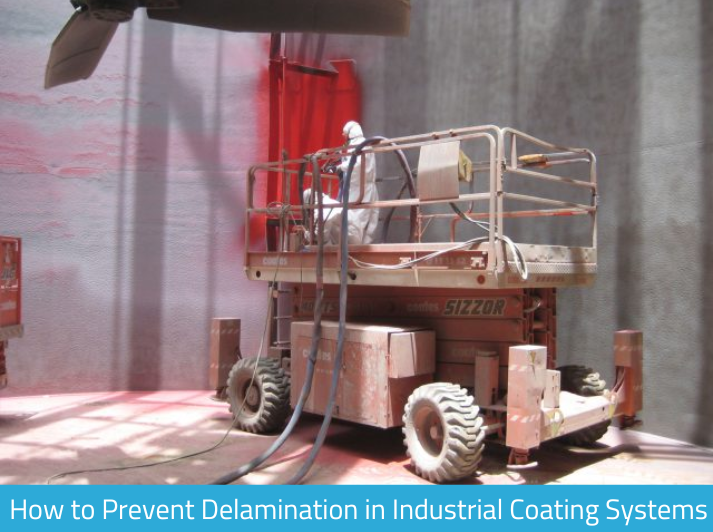
Delamination often combines several of the causes above and shows up as an entire section of coating detaching in one piece, sometimes with the primer still attached to the substrate and other times pulling away cleanly.
Steps to reduce the risk of delamination in an industrial coating system:
- Confirm surface cleanliness against a recognized standard such as SSPC-SP or ISO 8501 before any primer is applied.
- Verify substrate and ambient conditions, including dew point spread, using a surface thermometer and hygrometer throughout application, not only at the start of the shift.
- Apply coatings within the stated dry film thickness range per coat, since both under and over application can create internal stress that leads to separation.
- Respect intercoat and full cure times published on the technical data sheet before placing the system into service or exposing it to immersion or chemical contact.
- Inspect penetrations, seams and terminations, which are the locations where delamination most commonly initiates on roofing and lining systems.
Environmental and Chemical Exposure Factors
Beyond application errors, ongoing exposure conditions play a large role in long term coating performance. Coatings exposed to standing water, frequent freeze thaw cycles, high UV index locations, or chemical splash and immersion service each place different demands on the film. A coating validated for atmospheric exposure is not automatically suitable for secondary containment or wastewater immersion service, and product selection should reference the coating manufacturer’s chemical resistance chart alongside site specific exposure data.
Practical Steps to Prevent Elastomeric Coating Failure
- Start with a written surface preparation specification and verify it is followed, not assumed.
- Test substrate moisture content before scheduling coating work, particularly on concrete and masonry.
- Match primer chemistry to both the substrate and the topcoat rather than substituting products on site.
- Apply coatings within the manufacturer’s stated temperature, humidity and dew point parameters.
- Maintain the specified wet film and dry film thickness using a wet film gauge during application and a dry film thickness gauge after cure.
- Schedule periodic inspection of coated assets, especially in high movement areas such as joints, corners and penetrations, to catch early signs of cracking or blistering before they progress to delamination.
Building a More Resilient Coating System
Most elastomeric coating failures trace back to a mismatch between the coating, the substrate condition and the environment it has to endure, rather than a flaw in the coating chemistry itself. A qualified industrial coatings manufacturer will typically provide a documented specification, surface preparation guidance and application parameters specific to the substrate and exposure involved. Working from that documentation, and verifying conditions at every stage of application rather than only at the start, is what separates a coating system that lasts for its intended service life from one that requires early rework.
Table of Contents