
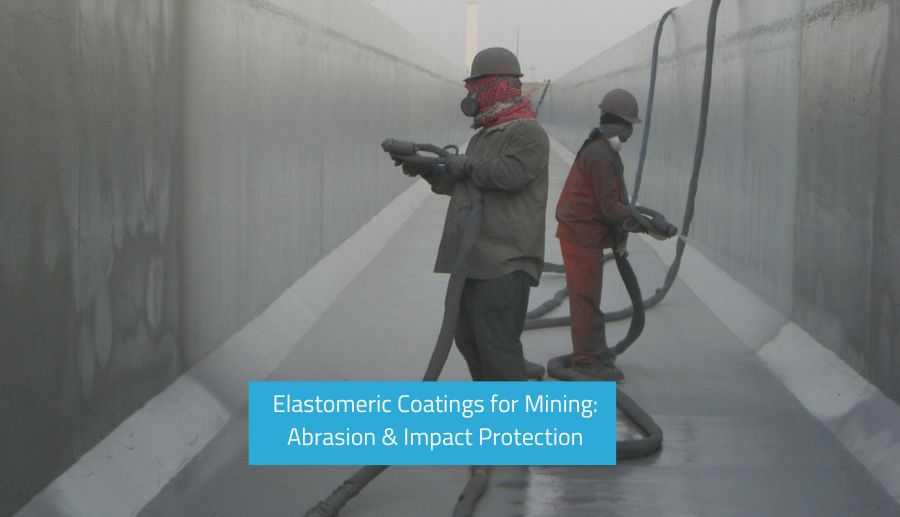
Role of Elastomeric Coatings in Pipelines, Chutes and Hoppers: Solutions for Mining Operations
Elastomeric coatings are purpose-built protective solutions for high-wear mining surfaces – particularly slurry pipelines, chutes and hoppers that endure constant abrasion, impact and corrosive slurry flow. This article covers how these coatings work in real mining conditions, the material science behind their performance, how to select the right system and what makes Nukote Coating Systems a leading elastomeric coating manufacturer trusted across Texas and the broader USA.
Mining infrastructure operates under extreme stress. Slurry pipelines carry abrasive ore particles at high velocity. Chutes and hoppers absorb repeated impact from bulk materials. Without adequate surface protection, these assets deteriorate rapidly – driving up replacement costs, increasing downtime and creating safety risks on-site.
Elastomeric coatings have become the protective solution of choice across mineral processing, coal handling and hard rock mining operations. Their ability to flex under impact while resisting surface wear makes them uniquely suited to environments where rigid coatings crack, delaminate or simply wear through.
Elastomeric Coatings and the Physics of Abrasion in Slurry Systems
Slurry pipelines carry mixtures of water, fine ore and often acidic or alkaline process chemicals. The damage mechanism is two-fold: hydraulic abrasion from particle-laden flow and chemical attack from the process solution itself.
Standard epoxy or polyurethane linings resist one or the other, but rarely both – and neither handles the micro-impact fatigue that builds up over thousands of hours of operation. Elastomeric coatings absorb kinetic energy from abrasive particles rather than resisting it directly. The elastomer deforms momentarily on particle contact and then recovers, distributing wear forces across a larger surface area rather than concentrating them at a single point.
This elastic energy recovery is what separates elastomer-based systems from brittle alternatives. In slurry pipeline applications, this translates to measurably lower annual wear rates – particularly in elbow sections and tee junctions where directional changes amplify abrasion intensity.
Elastomeric Coatings Selection: What Mining Engineers Look For
Choosing an elastomeric coating manufacturer for critical mining assets is not just a procurement decision – it is an engineering one. Mining engineers evaluate coating systems based on elongation at break, hardness (Shore A or D), tear strength, chemical resistance and bond strength to the substrate.
For slurry pipelines specifically, the coating must also demonstrate resistance to hydrolysis and wet adhesion loss. Many coatings perform well in dry lab conditions but fail in sustained wet immersion environments. Field-validated performance data from comparable mining applications carries more weight than laboratory certificates alone.
Nukote Coating Systems has built its position as a trusted elastomeric coating supplier by developing systems specifically tested under the wet abrasion and impact conditions found in live mining environments – not just in controlled test chambers. That distinction matters when specifying coatings for infrastructure where failures are expensive and repairs are logistically complex.
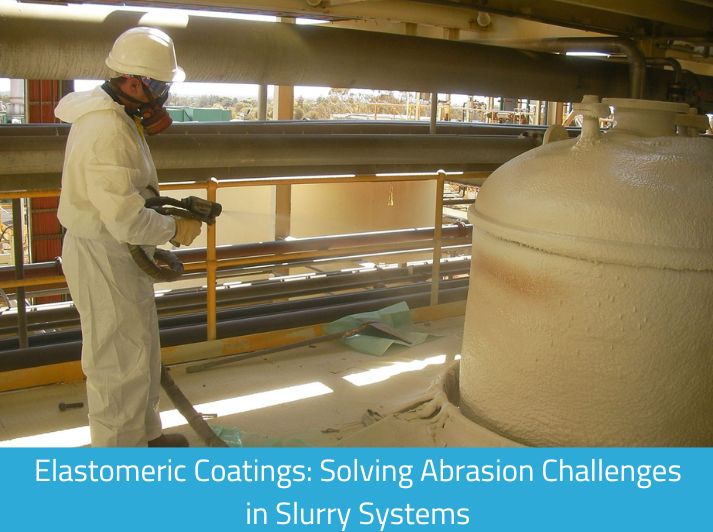
Mining Operations & Common Application Zones for Elastomeric Coatings in USA
Across USA mining operations – from iron ore processing in the Great Lakes region to phosphate mining in Florida and copper operations in the Southwest – elastomeric coatings are used in a defined set of high-wear zones.
Slurry transfer pipelines, especially in tailings management systems, represent the highest-volume application. Cyclone feed lines and pump discharge lines are also high-priority zones, as are overflow launders and thickener feedwells where turbulent slurry flow causes erosive wear at the liquid surface interface.
Chutes and transfer points in bulk material handling circuits present a different challenge. Here, impact from falling rock ore or coal is the dominant wear mechanism rather than hydraulic abrasion. Elastomeric coatings in USA must combine high elongation with sufficient hardness to prevent permanent deformation under repeated loading. A softer compound absorbs impact but may cold-flow under sustained pressure from material pileup. Selecting the correct hardness grade for the specific material drop height and lump size is essential.
Hoppers present both wear mechanisms simultaneously – impact at the top where material is loaded and abrasion at the outlet where material converges and accelerates. Elastomeric coating systems with gradient hardness profiles or dual-layer systems combining a tough impact-resistant base coat with a harder abrasion-resistant topcoat, are increasingly used in hopper applications.
Demand of Industrial and Mining Infrastructure for Elastomeric Coatings in Texas
Texas hosts a significant concentration of industrial minerals mining, oil sands processing infrastructure, chemical processing plants and bulk material handling facilities. Elastomeric coatings in Texas are applied not only in traditional mining contexts but also in the extensive pipeline infrastructure supporting energy sector operations – particularly in slurry injection lines, produced water handling systems and sulfur processing facilities.
The Gulf Coast’s combination of high ambient humidity, temperature extremes and chemically aggressive process streams creates demanding conditions that ordinary coatings cannot sustain. Nukote Coating Systems operates with direct knowledge of these regional conditions, supplying coating systems that are formulated and applied to withstand the specific thermal cycling and chemical exposures common to Texas industrial sites.
Our Other Product
Elastomeric and Ployurea CoatingsRole of Elastomeric Coating Manufacturer in Surface Preparation and Application Standards
Even the best elastomeric coating system will fail prematurely if applied over inadequate surface preparation. In mining environments, substrate contamination from process oils, mill scale and residual slurry deposits is common. The standard for surface preparation in immersion and high-abrasion service is SSPC-SP 6 (Commercial Blast) at minimum, with SSPC-SP 10 (Near-White Metal Blast) required for the most demanding applications.
Profile depth matters as well. Elastomeric coatings require sufficient anchor profile – typically 2.5 to 3.5 mil – to achieve the mechanical bonding needed for long-term adhesion under wet and dynamic conditions. Application by plural-component spray equipment is standard for polyurea and polyurethane elastomer systems, given the fast gel times involved. Mishandled application, including incorrect mix ratios, substrate temperature below dew point or insufficient film build, will compromise coating integrity regardless of the product specified.
The best elastomeric coating manufacturer in USA pairs product supply with technical application support – including surface preparation audits, equipment calibration guidance and post-application inspection protocols. This end-to-end capability is a key differentiator when selecting a long-term coating partner for mining infrastructure.
Elastomeric Coating Solutions in Recoatability, Maintenance and Service Life Extension
One practical advantage of elastomeric systems is their recoatability in the field. Unlike ceramic tile linings, which require full removal and replacement when damaged, elastomeric coatings can be spot-repaired or overcoated with compatible material – significantly reducing maintenance downtime and cost.
Service life in mining applications varies considerably by location and duty severity. In moderate-abrasion slurry lines, well-applied elastomeric coatings can achieve five to ten years of service before recoating is required. In extreme wear zones such as cyclone liners and mill discharge sumps, annual inspection and targeted touch-up is more appropriate.
Establishing a structured coating inspection program – including ultrasonic thickness measurement and adhesion pull-off testing – allows maintenance teams to identify thinning zones before breakthrough occurs. This proactive approach is consistently more cost-effective than reactive replacement of failed assets.
Conclusion
Elastomeric coatings are not a generic protective measure – they are an engineered response to the specific wear and impact conditions found in mining infrastructure. Slurry pipelines, chutes and hoppers each present distinct failure mechanisms that require matched coating solutions, correct application standards and ongoing maintenance programs. Nukote Coating Systems brings formulation expertise and field-validated performance data to mining operations across the USA, including Texas, providing coating systems that extend asset service life, reduce unplanned downtime and lower total maintenance costs over the long term.
Table of Contents